
"Notes" to the Belgic
Confession - Rev. C. Bouwman

|
|||
THE CREATION OF ALL THINGS, ESPECIALLY THE ANGELS
THE CREATION OF THE WORLD
-
Having discussed the Person
of God in the Articles 8 to 11, Guido deBres proceeds in Article 12 to discuss
the work of God regarding the creation of this earth and the creation of the
angels. Creation is the first of God's works revealed to us in Scripture. As
with anything else God has revealed, the doctrine of creation is a matter of
faith. Science cannot explain creation, nor can the human mind understand it.
In the words of Hebrews 11:3, "By faith we understand that the
worlds were framed by the word of God...."
HOW GOD CREATED THE WORLD
Genesis 1 is a chapter
very familiar to us all. There we read repeatedly, "Then God said
...". God spoke and there was light, He spoke again and the heavens,
sun, moon and stars, etc., came to be. Psalm 33:6, 9 summarises Genesis 1
as follows, "By the word of the LORD the heavens were made,
and all the host of them by the breath of His mouth.. For He spoke,
and it was done; He commanded and it stood fast.." This means
that prior to God's work of creation nothing existed. It was only after God
spoke that something was there.
Nothing existed prior
to God's work of creation; God made His handiwork out of nothing. As Hebrews
11:3 states, 'what can be seen was made out of what cannot be seen.' God spoke
and it was there. This is something no human being can do. Hence, creation
points up who God is. Having created the world the way He did, God
has revealed His greatness. Today there is much we can learn concerning God's
creation. Apart from all that is visible to the naked eye, microscopes reveal
and make us appreciate the many marvellous intricacies of God's creation.
One need only consider the ability of a tree to transport water and nutrients
from its roots to the leaves of its highest branches, the ability of plants
to regenerate themselves, the many complex systems of the human body. All
the minutest details of God's creation tell us something of God. In order
to accept and believe that God's act of creation took place by Him doing no
more than speaking, one needs to believe that God is Almighty. To consider
God as being anything less than Almighty is to belittle God, and to do so
results in difficulties in accepting the doctrine of creation. Hence it is
not surprising that the doctrine of evolution coincided with an unwillingness
to confess God as Almighty. What we are able to confess concerning creation
in Article 12 is dependent on all that has been confessed previously concerning
who our God is.
GOD'S PURPOSE IN CREATING THE WORLD
But what was God's purpose
in making the world? Did God make the world because He was lonely, or because
He wanted something upon which He could display His love? No. God, who has
been from all eternity, was not lonely nor did He need to display His love
upon something or someone. God created simply because it pleased Him to do
so. God created the world for the sake of His own praise. "The LORD
has made all for Himself...," we read in Proverbs 16:4. The
world is here for God. This is what we read in Isaiah 43:7 too. "Everyone
who is called by My name, whom I have created for My glory; I have
formed him, yes, I have made him." It is because God created all
things that the twenty four elders in Revelation 4:11 glorify God. Worshipping
God before His throne, they say, "You are worthy, O Lord, to receive glory and honour and power; for You created all things,
and by Your will they exist and were created."
One might well argue that
it is selfish, and consequently wrong, of God to create for the sake of His
own glory. However, the point here is whether one can correctly use the word
selfish for God. Selfishness speaks of a deficiency, of sin, and therefore
it cannot be used with regards to perfect God. God alone is God.
He made us, creatures on earth. For me to live for myself is an act of selfishness,
is sin, because I am created for God. To be selfish, to live for oneself detracts
from God's honour. God created me to live for Him. God is there for Himself,
and because He is God all of His creation is geared to Him. Article 12 states
that the ultimate purpose of God's creation and His sustenance and government
of His creation is "that man may serve his God." God's creation,
and hence man's existence too, is God centred. That is why Psalm 148
(as do many other Psalms) calls on all of creation to "Praise the
Lord," including the heavens, the angels, the sun, moon and stars,
the creatures of the seas, the wind, the mountains, the trees, the animals
on the land, the birds, and all people. It is simply because God is God that all of His creation should praise Him.
It is for the sake of
God's praise that each creature has been made the way it is. Then we may well
consider some creatures to be useless, ugly, harmful, a pest, and we may well
question why God made them that way. However, each animal's unique characteristics,
including its looks, its habits, its abilities, fulfil the purpose of serving
God the Creator. To use the words of Article 12, "... He has given
to every creature its being, shape, and form, and to each its specific task
and function to serve its Creator." Every creature has been created
in a specific way for God's glory. We may then have but little appreciate
for a spider or a snake, but God's evaluation of each of His acts of creation
-including the snake and the spider!- is this: "And God saw that it
was good." True, the fall into sin took place between creation
and today, and consequently God's creation suffered much damage. But this
does not alter the fact that what God created was good, and all creation today
still exists for the glory of the Creator.
We have many questions
concerning what things were like in Paradise and what the effects of the fall
into sin really were on creation. So many of these questions remain unanswered.
We don't know whether or not animals killed animals for food in Paradise.
But this we know for certain, that God made no mistake in what He created
and that each creature was created with its own specific gifts in order to
glorify God.
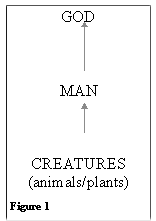 Not
only did God create the world, but He also put a structure in place in the
world, a hierarchy (see Figure 1). God created the creatures on the first
days of creation so that on the sixth day man could be placed on earth to
look after these creatures and in so doing could serve God. All creatures
exist for man's sake so that man might in turn praise God. Concerning man's
place in God's creation, Psalm 8 says, "What is man that You are mindful
of him, and the son of man that You visit him? ... You have made him to have
dominion over the works of Your hands; You have put all things under his feet,
all sheep and oxen - even the beasts of the field, the birds of the air, and
the fish of the sea that pass through the paths of the seas" (Psalm
8:4-9). Man is to look after God's creation and in so doing he is to praise
God. Therefore Article 12 states that God created, sustains and governs all
creatures "in order to serve man, to the end that man may serve his
God."
Not
only did God create the world, but He also put a structure in place in the
world, a hierarchy (see Figure 1). God created the creatures on the first
days of creation so that on the sixth day man could be placed on earth to
look after these creatures and in so doing could serve God. All creatures
exist for man's sake so that man might in turn praise God. Concerning man's
place in God's creation, Psalm 8 says, "What is man that You are mindful
of him, and the son of man that You visit him? ... You have made him to have
dominion over the works of Your hands; You have put all things under his feet,
all sheep and oxen - even the beasts of the field, the birds of the air, and
the fish of the sea that pass through the paths of the seas" (Psalm
8:4-9). Man is to look after God's creation and in so doing he is to praise
God. Therefore Article 12 states that God created, sustains and governs all
creatures "in order to serve man, to the end that man may serve his
God."
THE PURPOSE OF THE REVELATION OF GOD'S WORK OF CREATION
It is important to note
that the Bible refers repeatedly to God's act of creation, and does so in
the context of encouraging God's people in the circumstances of their lives.
For example, in Isaiah 40 we read of Israel in exile, complaining to Isaiah
that God had forgotten them, no longer cared about them, didn't look after
them. "My way is hidden from the LORD," they said, "and
my just claim is passed over by my God" (Isaiah 40:27). In order
to comfort and encourage Israel, Isaiah, in verse 28, reminds Israel of who
God is. He reminds them that God is not just a 'nobody,' but that He is the
LORD, ie, Jahweh, the God of the covenant, eternal, who never "faints
or is weary." And it is in the context of this description of God
that Isaiah reminds Israel that their God is "the Creator of
the ends of the earth." We understand that there is great encouragement
for the exiles in the reference to their God being the Creator; their God
is obviously mighty.
Similarly, reference is
made to creation in Jeremiah 32. God instructed Jeremiah to go and buy a field.
This was a perplexing instruction for Jeremiah, because the city of Jerusalem
was surrounded by the superior army of the king of Babylon. To the human mind,
then, the timing of this instruction to purchase land was ridiculous. But
Jeremiah could not pass this instruction off as such and therefore ignore
it, because it came from God. Therefore Jeremiah, struggling to come to grips
with this command, prays to God for understanding. It is noteworthy that his
prayer commences with a confession of who his God is, "Ah, Lord God!
Behold, You have made the heavens and the earth by Your great power and outstretched
arm. There is nothing too hard for You." If Jeremiah's God is the
Creator, who spoke and things were there, then there can be nothing too great
for Him. Then He can even deliver Israel from the Babylonians. What an encouragement
for Jeremiah in his difficulties!
Psalm 148 speaks of God's
work of creation. Repeatedly the psalmist calls upon persons and creatures
to praise God, "for He commanded and they were created."But here too the doctrine of creation does not stand on its own. For the
psalm concludes with a reference to the Creator being the God who adopted
a people for Himself. Verse 14 speaks of God's saints as being "A
people near to Him." That means to say, we are a people near to the
CREATOR! The doctrine of Creation does not just stand on its own, but rather,
it touches each of God's children, each one of us. What a Gospel this is,
that we can say that God the Creator has made me His child. It is not for
nothing that the Apostle's Creed doesn't just say in its first article, 'I
believe in God the almighty, Creator of heaven and earth.' Rather, it confesses,
"I believe in God the Father almighty, Creator of heaven and
earth." The inclusion of the title 'Father' makes it personal; it
puts me into the picture. For if God the Creator is Father, then I am the
child of the Creator. The knowledge that the Creator of the world is my Father
offers comfort and perspective to my life.
Then it becomes clear to us why people in the world around us live uncomforted, for they see their lives as the products of chance; not believing in God they lack the comfort of the care this God provides to His people.
THE CONSEQUENCES OF THE DOCTRINE OF CREATION
Three consequences follow from the reality that God created the world.
1. The doctrine
of creation determines what my relation with God must be. The doctrine of
creation is fundamental to all religious and ethical questions. If He formed
me, it follows that I am to acknowledge Him, serve Him. We are not our own,
but belong to Him, our Creator. We exist because of Him, and therefore it
is simply illegitimate and contradictory to live without Him.
2. The doctrine
of creation determines what my relation with other persons and creatures must
be. God made us all, and therefore we all belong together. I am then to give
room and place to the other.
3. The doctrine
of creation determines what my relation with the entire created world must
be. The human race forms part of the created world, but at the same time has
a unique place in this world. Though we have received dominion over all creatures,
we are not to exploit the world selfishly (and possibly short-sightedly).
"The earth is the Lord's, and all its fullness, The world and those who
dwell therein" (Ps 24:1). So it is for us to treat all creation with
respect.
THE CREATION OF THE ANGELS
God did not just create
the physical, visible world, but also that which is invisible, for example,
the angels. The Bible speaks of two kinds of angels: those that are good,
called angels, and those that are bad, called demons. These demons have a
leader in Satan. In Article 12 deBres has stated that God created all things,
including the angels; this includes the demons and Satan. This is a point
we may not forget: Satan and the demons are simply creatures. Satan is not
a second god; he is not on a level with God. Rather he is a creature. This reality determines our thoughts concerning Satan (see below).
We do not know when God
created the angels. In Genesis 1:1 we read "In the beginning God
created the heavens and the earth." The rest of the chapter relates
how God created the earth. We are not told how God created the heavens, which
includes the creation of the angels. The reason why this has not been revealed
to us is that heaven is not the focus of God's revelation. The focus of God's
revelation is the earth. Therefore we are only told things concerning heaven
in so far as it affects the earth. From Job 38:7 we know that the angels were
there when God created the earth. In verse 4 of this chapter God challenges
Job and asks him where he was "when He laid the foundations of the earth";
this is a reference to what is revealed to us in Genesis 1. In verse 7 we
are told that when God laid the foundations of the earth "... the
morning stars sang together, and all the sons of God shouted for joy." 'Sons of God' is a reference to the angels (cf Job 1). We don't know when
God created them, nor do we know how He did it. We do know that, by the time
God created the world, the angels were there. More we need not know, since
God has not revealed more to us. It is sufficient for us to know that they were there.
GOD'S PURPOSE FOR CREATING THE ANGELS
When God created, the
angels did not assist God. Rather than assisting God, the angels were praising
God. To praise God is the purpose for which the angels have been created.
The angels exist for God's glory. That is also God's purpose for creating
the world. In Isaiah 6 we read of Isaiah's vision of the Lord seated on His
exalted throne. Above His throne stood seraphim, which are angels. We are
not told how many there were, but we do know that they were busy giving praise
to their Maker. In verse 3 we read, "And one cried to another and
said: "Holy, holy, holy is the LORD of hosts; The whole earth is full
of His glory!" From the way this verse is written in Hebrew, we learn
that this was a continuous cry of praise to God.
But the angels do more
than praise God. They are also God's servants. In Isaiah 6:2 we read that
these seraphim had two wings to cover their faces and another two to cover
their feet. That is: they knew their place before God, and so showed an attitude
of humility in the presence of such a God. They also had two wings with which
they flew; ie they had a task to do, namely, to serve. Hebrews 1:14
tells us what this task entailed. Having made several references to the angels
in the preceding verses, verse 14 reads, "Are they not all ministering
spirits sent forth to minister for those who will inherit salvation?" The angels are servants, ministering to God's elect. Hence it was angels
that Jacob saw in his vision when he fled from home and was on his way to
Padan Aram. He saw a ladder stretched from earth to heaven, with angels "ascending
and descending on it" (Genesis 28:12). The angels were constantly
descending from heaven to earth to carry out God's commands for His people,
and ascending again from earth to heaven to report in heaven what was happening
on earth.
From Job 1:7 we understand
that this is what angels are engaged in doing. The angels congregated in God's
presence, and Satan (angel that he is) did too. God asked him where he came
from, and Satan answered God: "From going to and fro on the earth,
and from walking back and forth on it." But the contact between heaven
and earth via the angels is not merely a cold, detached contact. From Psalm
91:11,12 we know that the purpose of this contact is God's care for His children.
"For He shall give His angels charge over you, to keep you in all
your ways. In their hands they shall bear you up, lest you dash your foot
against a stone." God sends His angels to earth in order to protect
His people. Jacob's dream of these angels was more than just a dream. Jacob
knew God to be present in Bethel; God's angels were sent to earth to be with
God's fleeing servant.
In 2 Kings 6 we read how
the king of Syria was anxious to lay his hands on Elisha, but was unsuccessful.
He receives word that Elisha is in Dotham. "Therefore he sent horses
and chariots and a great army there, and they came by night and surrounded
the city" (verse 14). The knowledge of this does not upset Elisha,
as is evident from the way in which he reassured his fearful servant. Said
Elisha to his servant, "Do not fear, for those who are with us are
more that those who are with them" (verse 16). But the servant could
not see this until God opened his eyes so that he saw a reality not normally
seen by human eyes. "And behold, the mountain was full of horses
and chariots of fire all around Elisha." (verse 17). Note how
the verses 14 and 17 both speak of horses and chariots, but that verse 17
includes the words 'of fire.' Fire is a reference to God's presence (think,
for example, of the burning bush and the cloud of fire which led Israel through
the desert after having fled from Egypt). What the servant saw after God opened
his eyes was God's army. God's soldiers are His angels. Though Elisha's servant
didn't see them until the Lord opened his eyes, that didn't alter the fact
that the angels had been there all the time. God sends His angels to protect
His children. And we know that God does not change.
In Hebrews 1:14 we are
told that the angels are there to serve those who are to obtain salvation.
That was so in the times of the Old Testament, that was so in the times of
the New Testament, and that is still the case today. That means therefore
that the angels are spirits who minister to me too. No, I don't see them,
but that doesn't change the fact that they are here, sent to take care
of me, lest I dash my feet against the stone. With this revelation God again
provides comfort to His people in the ups and downs of the life we live. He
sends me His angels to protect me (see also Psalm 34:7).
SATAN
Article 12 says that God
created the angels good. Some of these angels, though, became evil. They are
known to us as demons. We are not told how they became demons, nor why they
fell; we're told only the fact that it happened. In 2 Peter 2:4 we read of "the angels who sinned." Likewise, in Jude vs 6 we read, "And the angels who did not keep their proper domain, but left their
own abode ..." The captain of these angels is Satan. The word 'Satan'
means adversary, enemy. This was not Satan's name before the Fall, but it
serves to describe what he became at his fall.
The task of the angels
is to praise God and to serve the elect, and even the demons are meant to
do this. In order to be able to perform this task, God gave certain gifts
and abilities. The task of the demons today, despite the fact that they have
fallen into sin, is still to serve God and the elect. However, because they
fell into sin, they don't do what they are supposed to do. Instead, they use
their God-given gifts to try to detract from God's glory, they hate the elect
and try to destroy the elect. Job serves as a clear example of what it is
that Satan tries to do, namely, to tear God's elect out of God's hand. In
Ephesians 6 we read of further efforts of the devil. There we read of the "wiles of the devil" (verse 11). In verse 12 Satan and the
demons are given four different titles: 1) principalities, 2) powers,
3) rulers of the darkness of this age, 4) spiritual hosts of wickedness
in the heavenly places. They are not just "flesh and blood",
people. They are instead spiritual beings, different from the creatures we
normally see. They cannot be destroyed by bombs or pesticides. They are a
powerful army that one ignores to his own peril. As to where they are to be
found, verse 12 says they are in the "heavenly places." Ephesians
2 portrays these demons as existing in heavenly places; they are called "the
prince of the power of the air" (vs 2). We know that the angels
are here with us this very moment for our protection, but it is possible too
that the demons are present simultaneously to try to frustrate God's work
and Word in our midst.
No, the demons are no
small enemy to contend with. They work to destroy God's people. They do the
opposite of what they were created for. We must take them seriously. 1 Peter
5:8 urges us to "be sober, be vigilant; because your adversary the
devil walks about like a roaring lion, seeking whom he may devour." In
Revelation 12:7-10 we read of Satan and his angels being cast out of heaven.
Satan cannot go to heaven any more like in the days of Job, for Christ has
since died and conquered Satan. Yet, Revelation 12:12 warns us how seriously
we are to take Satan. "Woe to the inhabitants of the earth and the
sea! For the devil has come down to you, having great wrath, because he knows
that he has a short time." Yes, we are to take him seriously! He
is here on earth with all his demons and does his utmost to tear us out of
God's hand. Do not belittle the evil one, nor his temptations. Take seriously
therefore the instruction of Ephesians 6:11 to "put on the whole armour
of God." In the words of Article 12: "The devils and evil
spirits are so depraved that they are enemies of God and of all that is good.
With all their might, they lie in wait like murderers to ruin the Church and
all its members and to destroy everything by their wicked devices." Remember,
it was deBres who wrote this, and his circumstances at the time included persecution,
false doctrine, the hatred of the Roman Catholics. Did deBres ever feel the
reality of Satan's wicked devices! DeBres knew that he had to take the Devil
and his demons seriously.
But it will not do for
us to take Satan too seriously. We are not to ascribe to the devil
divine qualities. Satan is not a god, nor is he almighty or all knowing. He
is merely a creature, and not to be put on a level with God. Do not, then,
give him too much credit! Like any other creature, he cannot move unless God
permits. On the one hand, then, take Satan seriously, but on the other, not
too seriously.
Having said this we thus
reject the error of the Manichees, as stated in the last paragraph of article
12, who claim that the devils, uncreated, are gods beside God. This is incorrect.
They were created, and are therefore only creatures.