
"Notes" to the Belgic
Confession - Rev. C. Bouwman

|
|||
THE CREATION AND FALL OF MAN AND HIS INCAPABILITY
OF DOING WHAT IS TRULY GOOD
WHO
IS MAN?
-
Article 14 revolves around
the creature MAN. The majority of mankind today lives in a vacuum, unsure
of who man is, where man comes from or what man's purpose is. As a product of
evolution, man is just an accident. Since there is no Creator, there is no-one
who decides what it is that man may or must do; there are no rights and wrongs.
TO BE MAN IS TO BE GOD'S IMAGE BEARER
The Scriptures tells us,
though, that God has created us. God did not create us as animals, but specifically
created us as man: human beings, people. God has taught us in His Word what
it means to be human. In Genesis 1:26,27 we read that to be human means to
be the image of God and conversely, to be the image of God means to be human.
Not only did God say that He would create man, but He also said who man would
be, what would characterise man as man; ie, "in our image,
according to our likeness." These two expressions are essentially
identical in meaning.
"Then God
said, "Let us make man in our image, according to our likeness..." When did God say this? 'Then,' ie, upon completion of His whole work
of creation, including the heavens, the seas, land, trees and plants, all
the animals. The whole world was ready for man, like a stage is prepared for
those who are to perform on it. From Genesis 1:27 we know that God did what
He said He would do. "So God created man in His own image; in the
image of God He created him; male and female He created them." We
are to take note here of the fact that God speaks of creating man as male
and female in the context of creating man in His own image. Here God made
a distinction between the two genders, but of both male and female He said
that they are created in the image of God.
TO IMAGE GOD IS TO ACT LIKE GOD
To be made in the image
of God does not mean that mankind looks like God. Rather, the point of the
expression 'image bearer of God' means that man ACTS like God. Man
is God's representative. The earth which God has created cannot see God. However,
God did purpose that the creatures of earth should be able to see what God
is like. That is the reason why God created people: to image God. As people,
we are to act as God acts, so that by looking at people one is able to see
something of what God is like. As God is holy, so man is to be holy; as God
is righteous, loving, wise, good, jealous, so one man is to be able to see
all these attributes of God in another. One could compare this to the office
of Governor General, the queen's representative, whose role it is not to look
like the queen but, rather, to act like her. This means that irrespective
of gender, race, age, gifts or capacities, every person has been made to image
God. Each person exists for the same reason. Each person on earth exists in
order to image God, so that in turn one sees what God is like and praises
Him.
From Genesis 1:26 we also
learn that man's imaging God is done through a further task which God has
given man: "...let them have dominion over the fish of the
sea, over the birds of the air, and over the cattle, over all the earth and
over every creeping thing that creeps on the earth." 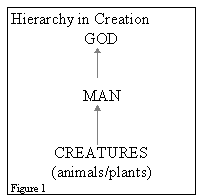 To
have dominion means to rule. How is man to rule? Man is to rule in
the same way as God Himself would rule. Man is to rule in the capacity of
king over all God's creatures (see Figure 1).
To
have dominion means to rule. How is man to rule? Man is to rule in
the same way as God Himself would rule. Man is to rule in the capacity of
king over all God's creatures (see Figure 1).
Man is to image God in
the way he rules over the creatures. Man is to have dominion in the same way
as God would have dominion. Not only are the creatures on earth for man, but
man is also on earth for the creatures, to have dominion over the creatures.
This is clearly pointed out in Psalm 8. On close observation of God's creation,
David is struck by man's comparative insignificance and he says to God, "When
I consider Your heavens, the work of Your fingers, the moon and the stars,
which You have ordained, what is man that you are mindful of him, and the
son of man that you visit him?" (vs 4, 5). Man is but small and insignificant
in comparison to God's created world in which he lives. But see now what God
has made man to be: "For You have made him a little lower than God,
and you have crowned him with glory and honour." God has made man
distinctly different from all creatures, and has placed him in a class near
to God, just a little lower than God. David goes on to laud the noble task
that God has given man: "You have made him to have dominion over the
works of your hands; You have put all things under his feet, all sheep and
oxen - even the beasts of the field, the birds of the air, and the fish of
the sea that pass through the paths of the seas. O LORD, our Lord, how excellent
is your name in all the earth!" (vs 6-9). This high calling to which
God has called man is also referred to as the 'Cultural Mandate.' Man is to
rule over all God's creatures in such a way that he reflects to all creatures
what God is like.
THE
EFFECTS OF THE FALL INTO SIN ON MAN'S ABILITY TO IMAGE GOD.
Before the Fall into sin,
we, as people, imaged God. When we fell into sin (and so deserted God's 'side'
in favour of Satan's; see Figure 2) we did not become pigs or plants; we remained people, and hence our task to image God remained also. 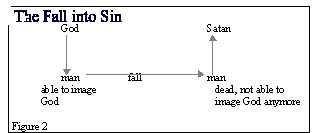 However,
we lost our ability to image God. When we fell into sin we became dead,
as we read in Ephesians 2:1 "And you He made alive, who were dead
in trespasses and sins." Dead is what we became with the
fall, depraved, sinful. So Solomon, at the dedication of the completed
Temple, could confess "there is no one who does not sin" ( 1 Kings 8:46). Similarly David, in Psalm 130: "If You, LORD, should
mark iniquities, O Lord, who could stand?" (vs 3). David admits
that every human being stands guilty before the Lord on account of
sin. Furthermore, what did God Himself see when He looked down on earth in
the days of Noah, before the Flood? "... And indeed it was corrupt;
for all flesh had corrupted their way on the earth" (Genesis
6:12). It is clear from Scripture that sin touched everyone. See also Psalm
14.
However,
we lost our ability to image God. When we fell into sin we became dead,
as we read in Ephesians 2:1 "And you He made alive, who were dead
in trespasses and sins." Dead is what we became with the
fall, depraved, sinful. So Solomon, at the dedication of the completed
Temple, could confess "there is no one who does not sin" ( 1 Kings 8:46). Similarly David, in Psalm 130: "If You, LORD, should
mark iniquities, O Lord, who could stand?" (vs 3). David admits
that every human being stands guilty before the Lord on account of
sin. Furthermore, what did God Himself see when He looked down on earth in
the days of Noah, before the Flood? "... And indeed it was corrupt;
for all flesh had corrupted their way on the earth" (Genesis
6:12). It is clear from Scripture that sin touched everyone. See also Psalm
14.
To what extent has man
become depraved? How evil is man? "Then the LORD saw that the wickedness
of man was great in the earth, and that every intent of the
thoughts of his heart was only evil continually" (Genesis
6:5). Here the depths of man's depravity is described in very strong language;
superlative after superlative is required to expose it for what it is. Not
only are man's actions, thoughts and words totally and continually evil, but
the whole intent and every intent behind man's actions, thoughts
and words is only and continually evil. This does not only describe man at
a certain stage in the course of his life, but it characterises fallen man
from the day of his birth to the day of his death. In response to Noah's burnt
offering after the Flood, "... the LORD said in His heart, "I
will never again curse the ground for man's sake, although the imagination
of man's heart is evil from his youth ..." (Genesis 8:21).
The imagination: the driving force behind man's thoughts is evil for the whole
duration of man's life. In Romans 8:7 we read that " ... the carnal
mind is enmity against God ..." Carnal flesh, man, is not
just indifferent to God, but he is in enmity with God, he hates God.
Scripture certainly uses
powerful language to describe the extent of man's depravity. What's more,
what Scripture says concerning the extent of man's depravity applies to every individual. Paul leaves no room for the notion that some people are more,
or less, sinful than another; all are equally and totally depraved. Are Jews
better than Greeks? Are we better than anyone else? Says Paul most emphatically
in Romans 3:9, "Not at all ..." Jews and Greeks are
equally guilty of sin. Paul then quotes a most condemning list of Old Testament
texts which in no uncertain terms testify to the universality and depth of
man's depravity. "As it is written: "There is no one righteous,
no, not one; There is no one who understands; There is no one who
seeks after God. They have all gone out of the way; they have together become unprofitable; There is no one who does good, no, not one." (Romans 3:10-12).
 Nor
Paul does not stop here. Not only must all people admit to the fact
of being depraved, but all people must also admit the great depth of their depravity. Says Paul, all people are to admit that "their
throat is an open tomb; with their tongues they have practised deceit; the
poison of asps is under their lips; whose mouth is full of cursing and bitterness.
Their feet are swift to shed blood; destruction and misery are in their ways;
and the way of peace they have not known. There is no fear of God before their
eyes" (Romans 3:13-18). So deeply has man fallen that all he can
do is speak evil, deceive, lie, threaten, curse, hurt, kill, destroy. Man
totally lost any regard for God, and his actions and thoughts reflected this.
Nor
Paul does not stop here. Not only must all people admit to the fact
of being depraved, but all people must also admit the great depth of their depravity. Says Paul, all people are to admit that "their
throat is an open tomb; with their tongues they have practised deceit; the
poison of asps is under their lips; whose mouth is full of cursing and bitterness.
Their feet are swift to shed blood; destruction and misery are in their ways;
and the way of peace they have not known. There is no fear of God before their
eyes" (Romans 3:13-18). So deeply has man fallen that all he can
do is speak evil, deceive, lie, threaten, curse, hurt, kill, destroy. Man
totally lost any regard for God, and his actions and thoughts reflected this.
So where does that leave
me? What kind of a person can I say that I am? The 'word picture' Paul painted
of sinful man is a picture of myself. In Paradise I was able
to image God perfectly - but I fell into sin, and consequently I became sinful, depraved, dead. I had been created by God to image Him, to
reflect His characteristics. Yet all that I can do is demonstrate
unrighteousness, unholiness, unfaithfulness, foolishness, hatred; the exact
opposite of God's characteristics. How deep was my fall from the noble and
glorious position God created me to fill, as described in Psalm 8! (See Figure
3. The fall is not partial, but from glorious top to absolute bottom).
How evil am I? Am I able
to kill my own child? Am I capable of selling my own brother to foreign slave
dealers? Do I have it in me to betray my parents and hand them over to death?
Would I hand over a perfect man to the authorities? We'd like to answer such
questions with an emphatic 'NO'! Yet Scripture does not permit that answer.
The Lord is condemning of His evaluation of the human race: "every intent of the thoughts of his heart was only evil continually." Because people are so terribly depraved, ten sons of Jacob sold their own
flesh and blood, brother Joseph, to Midianite traders. The Jews, God's chosen
people, were honoured in their day to have a perfect man in their midst, a
man who never sinned, but with one voice they called out to "Crucify
Him, crucify Him." God made man noble, yet through the fall into sin
man fell as low as he could possibly fall, rendering himself capable of doing
the most atrocious deeds. Says Article 14, "... he transgressed the
commandment of life which he had received; ... he corrupted his whole nature.
... Since man became wicked and perverse, corrupt in all his ways,
he has lost all his excellent gifts which he had once received from God."
This radical extent of
our depravity is echoed in the Catechism. To the question whether we are "so
corrupt that we are totally unable to do any good and inclined to all evil",
the Catechism answers with an emphatic "Yes" (LD 3, Q&A
8). Having fallen into sin, and having thereby positioned ourselves in Satan's
camp, we have made ourselves capable of all kinds of evil. By nature
I am not above doing the most wicked deed one could imagine. Yes, says the
Catechism so categorically, I am so depraved that by nature my every imagination,
intent and action is totally evil.
FALLEN MAN REDEEMED BY CHRIST
But here is displayed
the glorious marvel of redemption! Whereas I had reached 'rock bottom' while
I was dead, God sent Christ to the Cross for me (see Figure 4, Point 1). In
so doing, God reached down into the gutter as it were, to pull me out. The
great depth into which God had to reach spells out all the more the great
extent of God's mercy and kindness in saving a wretched sinner like me.
God sent Christ: true
man. As true man Christ is also the image of God. As Scripture says: "
... Christ, who is the image of God ..." (2 Cor. 4:4). Likewise,
Colossians 1:15 states, concerning Christ, "He is the image of the
invisible God." As perfect man, Christ images perfectly what
God is like. Philip, Jesus's disciple, once asked Jesus, "Lord, show
us the Father..." to which Jesus replied, "He who has seen
me has seen the Father ..." (John 14:8,9). Jesus, without sin, as
perfect as we were in Paradise, reflected God perfectly. Christ never lied,
but rather showed God to be a God of truth. He never hated in a way differently
from the way God hates. He never coveted, thus reflecting God to be a God
who shows care to, and supplies for, His children. Christ imaged God's holiness
and God's righteousness; Christ imaged God totally, reflecting all of God's
characteristics perfectly (Figure 4, Point 2).
REDEEMED MAN REGENERATED BY THE HOLY SPIRIT
In paying for sin by His
sacrifice on the cross, Christ took the elect from Satan's side and brought
them back to God's side: justification (Figure 4, Point 3). However, were
it not for the regenerating work of the Holy Spirit, man, ransomed by Christ's
blood from the power of Satan, would have remained dead, paralysed in sin.
As Lord's Day 3 (Q&A 8) states, man is so corrupt and only capable of
evil "unless (he is) regenerated by the Spirit of God." God gave the Spirit to recreate man, to transform man so that he might
once again be the image of God, just as God had created man to be in the beginning
(Figure 4) . 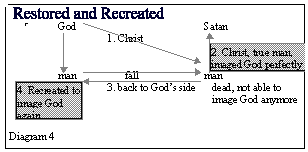
To the believers in the
Church at Corinth, Paul writes that they "... are being transformed
into the same image from glory to glory, just as by the Spirit of the Lord" (2 Corinthians 3:18). The recreating work of the Holy Spirit is mentioned
in Paul's letter the Colossians, "Do not lie to one another, since
you have put off the old man with his deeds, and have put on the new man who
is renewed in knowledge according to the image of Him who created him" (3:9,10). The 'new man' or recreated man has been recreated according to a
'pattern,' a 'mould,' namely, the image of God. Paul mentions the concept
again in his letter to the Ephesians, " ... that you put on the new
man which was created according to God, in righteousness and true holiness." (4:24). Recreated man is enabled to show something of God's righteousness
and holiness in his thoughts, words and actions. So Lord's Day 32 (Q&A
86) can summarise Scripture in this way: "Christ, having redeemed
us by His blood, also renews us by His Holy Spirit to be His image."
Yet recreated man is not
enabled to image God perfectly again. In the text quoted above from 2 Corinthians
3:18, Paul had spoken of "being transformed". This means
to say that the Spirit's work of regeneration is not an instantaneous action,
but an ongoing process in the course of man's life. Lord's Day 33 (Q&A
88 & 89), in describing what conversion and the dying of the old nature
means, explains it in terms of more and more hating and fleeing from
sin. It is not until the final day that we shall be totally restored to the
image of God.
Meanwhile, we are enabled
to image God again. In fact, by imaging God in our daily living, we in effect
evangelise. That is: evangelism does not mean to speak of Christ at an opportune
moment (though life does present such opportunities and one should make use
of them), but rather, evangelism is all about reflecting God through my attitudes,
words and deeds. It means always to live Christ, reflecting in my life what
He is like. The ten commandments serve as a guide in this respect. Since God's
characteristics are pointed up in them, a life of obedience to them will reflect
God's characteristics and will image God.
Since I am allowed to
be a child of God, I am allowed also to have again the task God gave to all
mankind in the beginning, namely, to have dominion over God's world. In my
work I am ruling over God's world, and I am reflecting what God is like. This
knowledge gives perspective to my work: why I work and how I work. I am no
accident, am not here by chance. I am here for a reason, namely, to show God's
glory.
MAN DOES NOT HAVE A FREE WILL
Having confessed on the
basis of Scripture that man is "wicked and perverse, corrupt in all
his ways," Article 14 rejects "all teaching contrary to this
concerning the free will of man, since man is but a slave to sin and no one
can receive anything except what is given him from heaven."
Before the Fall, Adam
(and in him all mankind) did have a free will to do good or evil. He could
choose between two kingdoms. He had the free will to stay with God or cross
the boundary between God's kingdom and Satan's and join Satan. With the Fall,
Adam (and so we all) chose to join the kingdom of Satan. As a result, Adam
had a free will only in the sense that he could choose certain courses of
action within the boundaries of Satan's kingdom. (One could compare
this to being in a car rolling down hill: the descent is inevitable; all one
can do is steer to the left or the right.) Having chosen for Satan, Adam had
lost the free will to choose for God, to choose to cross the boundary between
the two kingdoms and re-enter God's kingdom. After all, with Satan man is
dead, and the dead cannot do anything.
In His plan of salvation,
God sent Christ to bring the elect from Satan's kingdom over the boundary,
back into God's kingdom. Those who have been returned to the kingdom of God,
however, do not receive a free will. Sin remains within them, and so the saved
are totally dependent on God to do any good. Man can decide to sin, ie, side
with Satan, cross the boundary into Satan's kingdom, but God in His grace
holds on to His elect and brings them back to His kingdom. The good that God's
redeemed children do is not the result of their free will to do good but is
purely the result of God's work in them. As a redeemed child of God it is
my duty to do good and so I try, but I have only the Lord to thank, and not
myself, for what He enables me to do in service to Him.